How to play BTC Up or Down
Bitcoin Up or Down takes about ten seconds to learn: pick a round, see the price to beat, choose a bet size and buy UP or DOWN before the clock runs out. This guide covers the rules, when each round starts, how the price to beat is set and how to read the live chart.
How to play BTC Up or Down
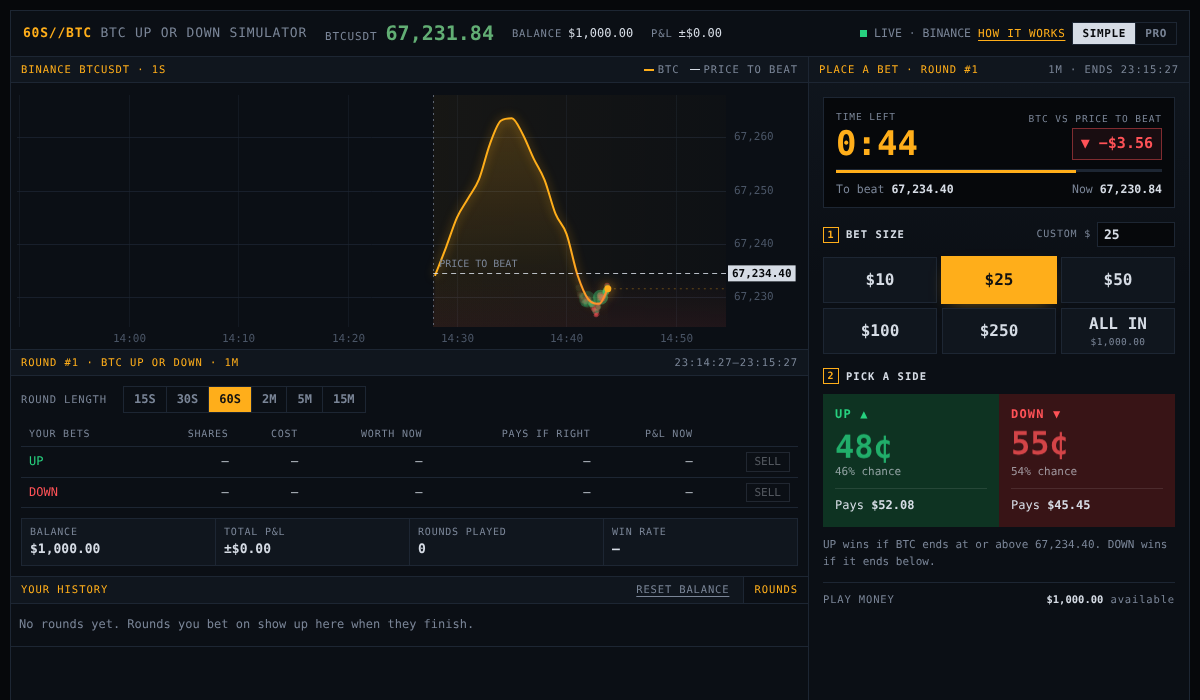
Pick a round, choose a bet size, then buy UP or DOWN before the clock runs out.
- Pick a round length. Choose 5, 15, 30 or 60 seconds, or 2 minutes, for fast rounds, or the 5 minute and 15 minute rounds that run on the clock.
- Check the price to beat. The price to beat is BTC's price when the round opened. The bet panel shows how far BTC is above or below it and how much time is left.
- Choose your bet size. Tap $10, $25, $50, $100, $250 or All in, or type a custom amount.
- Buy UP or DOWN. Buy UP if you think BTC will finish at or above the price to beat, or DOWN if you think it will finish below. Each button shows what you get back if you're right.
- Wait for the close or sell early. When the timer hits zero, winning shares pay $1 each and losing shares pay nothing. You can also sell before the end to lock in a profit or cut a loss.
Bet on several round lengths at once
Every round length runs at the same time, all the time. You can hold a 15-minute bet while you play 30-second rounds, then switch back to check on it. Switching length never cancels anything: each bet settles on its own clock, and the Your open bets table lists every live bet with its time left and a Sell button.
The challenge is that each side's price moves every second, so the same call can be a bargain at 55¢ and a bad deal at 90¢.
BTC Up or Down round schedule
5-minute and 15-minute rounds follow the clock; the fast rounds run back to back from when you start.
| Round length | When rounds start | Rounds per hour | Rounds per day |
|---|---|---|---|
| 5 seconds | When you arrive, then back to back | 720 | 17,280 |
| 15 seconds | When you arrive, then back to back | 240 | 5,760 |
| 30 seconds | When you arrive, then back to back | 120 | 2,880 |
| 60 seconds | When you arrive, then back to back | 60 | 1,440 |
| 2 minutes | When you arrive, then back to back | 30 | 720 |
| 5 minutes | :00, :05, :10 … :55 on the clock | 12 | 288 |
| 15 minutes | :00, :15, :30, :45 on the clock | 4 | 96 |
Times follow your device's clock, so 5-minute and 15-minute rounds line up with the same windows used by real Bitcoin Up or Down markets in every time zone.
How is the price to beat set?
The price to beat is Bitcoin's price at the moment the round opens. In BTC Up/Down it's the first live trade price at the start of the round from the exchange feed you're using (Binance by default).
Real markets each define it in their rules, and the details matter. Kalshi's 15-minute Bitcoin contracts, for example, use the previous window's final value as the next window's target, and settle on an index averaged over the final minute rather than a single last trade (summary of Kalshi's 15-minute rules). That's why a price on one exchange's chart can differ by a few dollars from a real market's settlement value.
Reading the live BTC chart
The chart follows Bitcoin's price second by second and zooms with volatility: in and tight when the market is calm, out when it moves. The dashed line is the price to beat, the shaded area is the current round, and the CLOSE line slides in from the right as the round ends. When you hold a bet, your winning side of the line is tinted, and your buys appear as small triangles at the price you entered. In Pro view you'll also see a 20-second EMA and volume bars coloured by buyers and sellers.